Skip to content

Safe Labs launches Safenet transaction checks for Safe multisig accounts

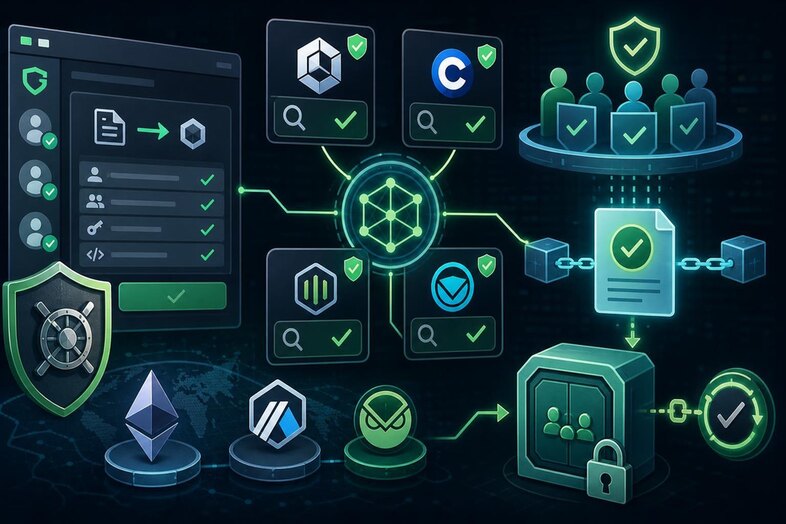
Safe Labs launched Safenet on 21 October 2026, adding transaction checks by independent security firms to Safe{Shield}, its security co-pilot for Safe accounts. The network gathers verdicts before a transaction executes and records the result onchain. Safe Pro users can access it on Ethereum, Arbitrum and Gnosis Chain. Safenet is designed to assess what a transaction will do, rather than relying solely on a warning shown in a wallet interface.…

More

Japan’s FSA weighs DeFi access limits and self-custody wallet safeguards

Japan’s Financial Services Agency (FSA) is considering whether to restrict access to decentralised finance services without adequate anti-money laundering and counter-terrorist financing controls, according to a discussion paper reported by Cointelegraph. The paper also raises questions about the responsibilities of businesses that interact with DeFi and about possible safeguards for self-custodial wallets. It presents issues for discussion, not…

More

Ethereum Foundation recommends Keccak-256 for proposed security overhaul

The Ethereum Foundation has recommended Keccak-256 as the hash function at the centre of proposed defences against quantum computing and AI-assisted attacks, according to a blog post published on Nov. 24. The recommendation is a research direction, not an implemented network change: core developers have not approved the related Ethlabs proposal, and the Foundation’s published roadmap still targets December 2029 for quantum resistance. The choice…

More

Vitalik Buterin urges verifiable chips as hardware wallet tampering evolves

Ethereum co-founder Vitalik Buterin has called for computer chips to be more verifiable, warning that hardware wallet attacks could move beyond inserted implants to malicious replacement chips that look legitimate. In a blog post reported by Cointelegraph, Buterin said many commercial open-source chips do not reveal enough about their physical construction for outsiders to check whether the hardware matches its published design. The distinction…

More

Safe Labs Introduces Policy Engine for Onchain Safe Transaction Rules

Safe Labs has introduced the Safe Policy Engine, a set of contracts designed to enforce transaction rules on Safe accounts, with availability for Safe Pro Business and Enterprise teams planned by the end of Q4 2026. The company says the system will check transactions onchain through the Safe Transaction Guard, while a designated co-signer can handle conditions that require information unavailable to a smart contract. Safe Labs announced the…

More

Safe sets out transaction defence and policy plans at Devcon 8

Safe Labs, the Safe Ecosystem Foundation and Safe’s research and development team brought transaction security, wallet privacy and post-quantum preparedness to Devcon 8 in Mumbai, according to a recap published by the team on 17 November 2026. The programme included talks and panels on multisig security, offensive AI and account-level controls, alongside the first Ethereum Forward Defence Summit. The team’s central security argument was that…

More

Safe Labs consolidates pending Safe activity in a multichain Queue Service

Safe Labs has launched the Safe Queue Service in production, bringing pending transactions, signatures, offchain messages and delegates into a single multichain API. The service already powers Safe{Wallet}, and integrations using the relevant Transaction Service endpoints must migrate before 19 January 2027. Previously, developers had to query the Safe Transaction Service separately for each chain and combine the responses to see pending…

More

Safe Queue Service consolidates pending Safe activity in one multichain API

Safe Labs has put the Safe Queue Service into production, giving integrations one API for pending Safe transactions, signatures, offchain messages and delegates across supported networks. The service already powers Safe{Wallet} and is intended to replace the Transaction Service endpoints used for those pending actions. The change affects developers who propose transactions, collect signatures, handle offchain messages or manage delegates. Safe…

More

Safe publishes agent skills for proposing multisig transactions

Safe Labs has published an open-source set of AI agent skills that lets Claude Code, Codex and Cursor read Safe accounts, explain transactions and draft proposals through the Safe{API}. Owners must still approve and execute every transaction under the Safe’s existing threshold rules. The skills combine instructions and helper scripts for common Safe tasks. They run on the Safe{API} and require a user’s own API key; Safe Labs says they do not…

More

Welcome

Welcome to the demo page of DataLife Engine. DataLife Engine is a multi-user news engine with a high functionality. First of all, the engine is designed to create news blogs and websites with a large information context. However, it has a lot of settings that allow you to use it for any purpose. The engine can be integrated into almost any existing design and it has no limatations for making new templates for it. Another key feature of DataLife Engine - is a low load on system resources. Server load will be minimal even when many users will be online, and you will not experience any problems with the information displaying. The engine is optimized for search engines. You can read about all the functional features on our page.

Discussion of all issues on the script is conducted here. Also, you can get prompt assistance there.
---
More

Latest from the blog

All news

Safe Labs launches Safenet transaction checks for Safe multisig accounts

Safe Labs launched Safenet on 21 October 2026, adding transaction checks by independent security firms to Safe{Shield}, its security co-pilot for Safe accounts. The network gathers verdicts before a transaction executes and records the result onchain. Safe Pro users can access it on Ethereum, Arbitrum and Gnosis Chain. Safenet is designed to assess what a transaction will do, rather than relying solely on a warning shown in a wallet interface.…

Read article

Japan’s FSA weighs DeFi access limits and self-custody wallet safeguards

Japan’s Financial Services Agency (FSA) is considering whether to restrict access to decentralised finance services without adequate anti-money laundering and counter-terrorist financing controls, according to a discussion paper reported by Cointelegraph. The paper also raises questions about the responsibilities of businesses that interact with DeFi and about possible safeguards for self-custodial wallets. It presents issues for discussion, not…

Read article

Ethereum Foundation recommends Keccak-256 for proposed security overhaul

The Ethereum Foundation has recommended Keccak-256 as the hash function at the centre of proposed defences against quantum computing and AI-assisted attacks, according to a blog post published on Nov. 24. The recommendation is a research direction, not an implemented network change: core developers have not approved the related Ethlabs proposal, and the Foundation’s published roadmap still targets December 2029 for quantum resistance. The choice…

Read article

Vitalik Buterin urges verifiable chips as hardware wallet tampering evolves

Ethereum co-founder Vitalik Buterin has called for computer chips to be more verifiable, warning that hardware wallet attacks could move beyond inserted implants to malicious replacement chips that look legitimate. In a blog post reported by Cointelegraph, Buterin said many commercial open-source chips do not reveal enough about their physical construction for outsiders to check whether the hardware matches its published design. The distinction…

Read article