Vitalik Buterin urges verifiable chips as hardware wallet tampering evolves
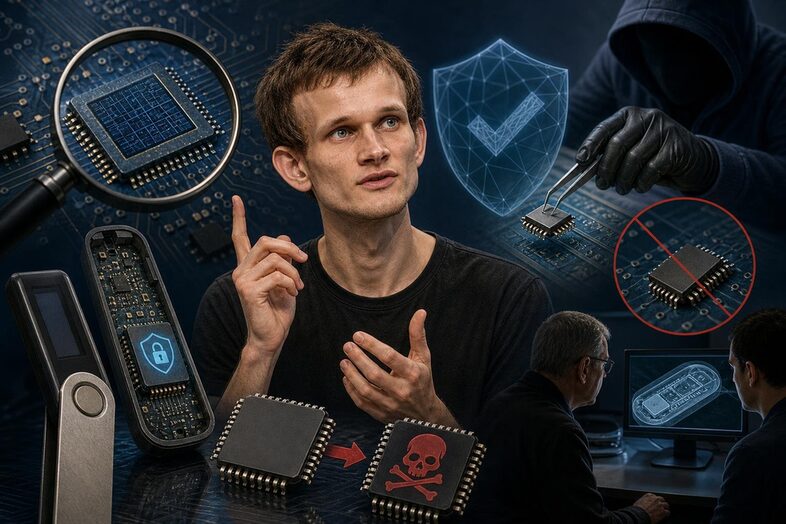
Ethereum co-founder Vitalik Buterin has called for computer chips to be more verifiable, warning that hardware wallet attacks could move beyond inserted implants to malicious replacement chips that look legitimate. In a blog post reported by Cointelegraph, Buterin said many commercial open-source chips do not reveal enough about their physical construction for outsiders to check whether the hardware matches its published design.
The distinction matters because making a chip’s programmed functions public does not, by itself, let an inspector confirm that the physical chip is built as described. Buterin’s concern is that someone could alter the hardware while retaining the appearance of an ordinary component. He warned that such tampering would not necessarily be visible to a buyer inspecting a device by eye.
Buterin’s comments respond to reported cases involving hardware wallets, devices used to hold keys and approve transactions. They do not describe a new Ethereum protocol or a change to wallet software. His proposal is a call for stronger verifiability at the chip level; the reporting gives no deployment date, implementation plan or formal standard for achieving it.
What chip verifiability would address
Open-source chip information can describe what a component is intended to do, but Buterin said that information may not provide a blueprint that allows people to verify the physical object. That leaves a gap between transparency about a design and evidence that a particular chip follows it. For hardware wallet makers and distributors, the issue is therefore not limited to whether a device’s software is publicly described: the physical components and the route by which a device reaches a customer also feature in the threat picture described in the report.
Buterin said chip inspections would remain work for specialists, including professional auditors, journalists and civil society groups, even if hardware designs were fully open-source. His argument does not suggest that every wallet user could independently inspect a chip. Instead, it places an important role on people and organisations able to examine hardware and make their findings available to others.
That distinction has practical implications for wallet operators. A published design or software update cannot, on its own, establish that a device contains the intended physical components. Meanwhile, the examples reported by Cointelegraph show that manufacturers have responded to suspected tampering with distribution changes, inspections and firmware. These measures address different parts of the problem; the source does not claim that any one of them proves a device is free of malicious hardware.
Recent reseller cases raised the stakes
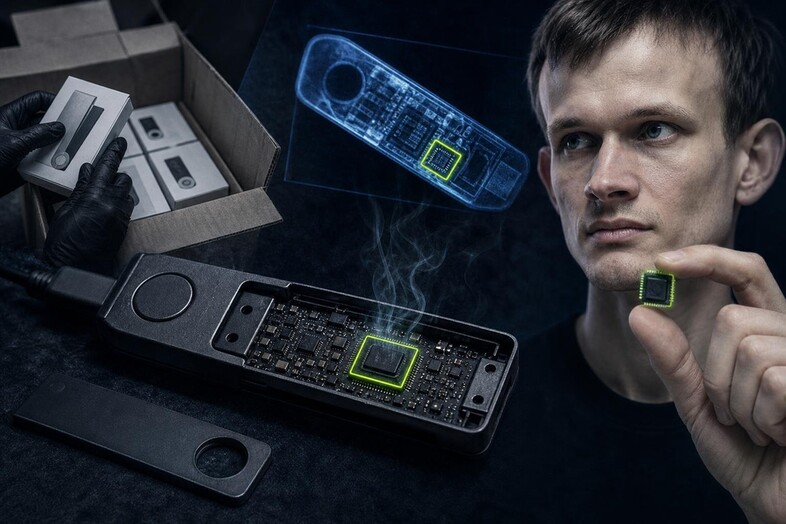
In October, Ledger said malicious implants had been found in devices sold through reseller CryptoBilis. According to the company, the implants captured recovery phrases and sent them over cellular networks. Ledger suspended sales through the reseller in Southeast Asia and Hong Kong, tightened its distribution rules and offered X-ray inspections after tampered devices were found beyond the region.
Trezor said in November that it had found similar implants in three devices sold through the same reseller. The company released a firmware update intended to stop the implants from capturing data and cut its reseller network by about 80%. Those are company-reported responses to identified devices. The report does not establish the number of affected customers or say that the cases involved the lookalike replacement chips Buterin warned could be used in future attacks.
The reported implants and Buterin’s warning should therefore be kept distinct. The implants were described as devices with added malicious hardware; the warning concerns a possible future approach in which a replacement chip could resemble a legitimate part. Buterin said this type of threat would be difficult to spot with the naked eye. The article does not report evidence that such replacement-chip attacks have already taken place.
Security and performance may diverge
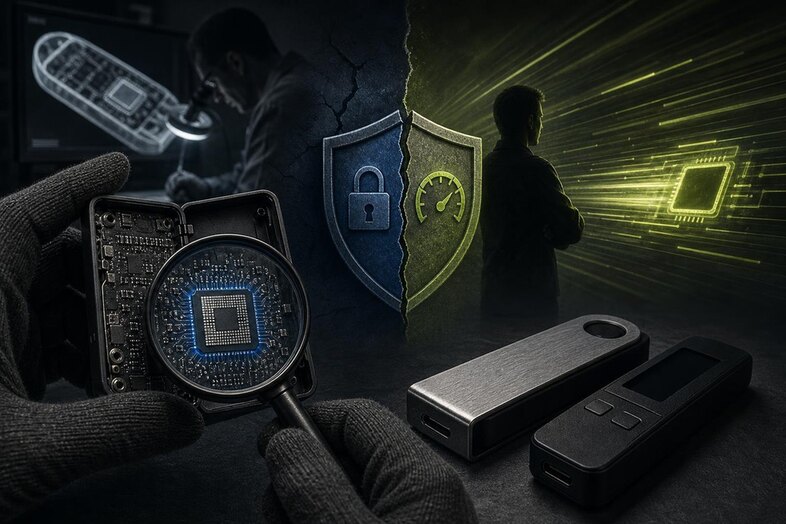
Buterin also acknowledged that making all hardware open-source may not be realistic given the commercial pressures companies face. He said he hoped the industry would develop a split between performance-oriented hardware and hardware designed for security. In his description, secure hardware could be “10x less efficient or more” and still handle most everyday applications.
That is a vision for how hardware development might evolve, not a released product category or a commitment from wallet manufacturers. The source does not identify a chip supplier, a design, a testing process or a date for such a divide to emerge. For developers and operators, the immediate issue remains the limits of what public information can verify: details about intended behaviour are not the same as a way to check the physical construction of each chip.
For users, the reported incidents underline that a hardware wallet’s security depends on more than its advertised functions. Ledger and Trezor described specific steps after devices from CryptoBilis were found to contain implants, but the report does not provide a general test that customers can apply to every wallet. Buterin’s broader point is that independent scrutiny of hardware may need to complement software transparency, with specialist inspectors doing work that ordinary buyers cannot readily perform.
Buterin framed the issue as one of participation as well as security, writing that computation should be open to participation and tinkering at the hardware layer. His call centres on making physical chips more verifiable, while the concrete responses reported so far remain Ledger’s distribution measures and X-ray offer, and Trezor’s firmware update and reduction of its reseller network by about 80%.